
While writing about the educational and entertaining Ultimate Johannesburg Tour I attended earlier this year, I realised my firsthand experience of the i session to understand how Johannesburg ended up in its current state, and what factors contributed to its decline. For a city with such a complex history of segregation, immense financial wealth for a select few, and contrasting inequality and hardship for the majority, Johannesburg’s architecture tells a vivid story. It openly displays its struggles and downfall, yet also hints at a revival that is far from over.
From the safety of our tour bus—which looked a lot like a local taxi but bore the tour agency’s branding—I photographed everything I could from behind tinted windows. Our guide, Tapelo, navigated the CBD like a pro, explaining that while there is a general understanding among residents that tourism improves the economy, safety relies on sticking with the guide and the presence of private security. Consequently, we stayed in the vehicle at all times, and Tapelo rarely stopped for more than a moment or two. I was endlessly intrigued by the historic buildings, deeply curious about modern life there, and admittedly sad about the state of the city.
What follows is the output of many hours spent cross-referencing my geo-located photos with Google Maps, Street View, and historical archives. Time definitely ran away from me during this exercise as I tried to figure out exactly what I had been looking at.
Johannesburg Park Station
Our first introduction to Johannesburg was driving over the Nelson Mandela Bridge from which Tapelo was pointing out Johannesburg Park Station below. You can see what initially looked like a bustling, well-equipped transport hub with dozens of blue passenger carriages lined up, Tapelo quickly pointed out as the opposite: it’s largely functioning as a train graveyard. Although the Passenger Rail Agency of South Africa (PRASA) still operates some services from the station, unfortunately the network was crippled by severe infrastructure vandalism and cable theft in recent years. As a result, a massive number of trains simply sit parked side-by-side, going nowhere.

Old Park Station
From the other side of the bridge is the historic Old Park Station. Nowadays it is a skeletal structure standing empty on an elevated platform, but it remains one of the oldest surviving structures in Johannesburg. It was prefabricated in the Netherlands by Dutch architect Jacob Frederik Klinkhamer, and the components shipped to South Africa for construction and opened to the public in 1897. Since it’s original site where it was opened, it has been dismantled and moved on two occasions to save it from redevelopment in 1952 and then to it’s current spot in 1993. There were big dreams for it over the years, one of which was turning it into a railway museum but since none of the plans have come to fruition, although it is occasionally used to shoot commercials, music events for local DJ’s and musicians, shows, conferences and exhibitions. I found the historic photograph from 1897 on https://commons.wikimedia.org/wiki/File:North-eastern_view_of_the_covered_platform_of_Park_Station_1897_-_NZASM_100.jpg.


Hijacked Buildings
You read that right. While most of us are familiar with the concept of car hijackings, in Johannesburg, entire multi-storey buildings get hijacked. At first, it sounded unbelievable that something like this could happen, but after some explanation from Tapelo and a bit of digging, the reality became clear: abandoned or neglected properties are seized by criminal syndicates who operate as ruthless slumlords, charging extorting rent from vulnerable people with nowhere else to go.
This crisis began snowballing in the late 1980s and early 1990s as apartheid segregation laws unraveled. Inner-city residential neighbourhoods like Hillbrow, Berea, and Yeoville transformed into mixed “grey areas” as people of all races moved in seeking economic opportunities. While initially vibrant, there was virtually no municipal planning to support this massive influx of people moving in. These areas soured under escalating poverty, while under-resourced and ill-equipped authorities failed to curb the rise of organised crime, allowing it to spill directly into the adjacent Central Business District.
The resulting panic triggered massive “white flight” and capital flight to affluent northern suburbs like Sandton. To compound the problem, commercial banks began “redlining” the inner city—refusing property loans and choking off private investment. World-class hotels like the Carlton and the Johannesburg Sun, along with major corporate towers like the ABSA towers, lost their customer base and shuttered, heavily fortifying their mothballed premises. When property owners failed or were unable to secure their vacant buildings, criminal gangs moved into the vacuum, establishing the informal slumlording networks seen today.
There are a few distinct clues you can look out for to identify a hijacked building: broken glass windows, windows ineffectively patched with cardboard or plastic, makeshift curtains, and shabby exterior paint. When a building has been cut off from municipal services, you will often see disorganised webs of electrical wires illegally strung from streetlights directly into the premises. Additionally, black soot marks above the windows indicate that residents have been forced to make indoor fires to cook or keep warm, while uncollected rubbish frequently piles up on the pavements outside.
You can read more about this complex shift at the Urban Strategy Lab’s breakdown of Joburg’s history.


Iconic Buildings
Currently known as the Life Centre Building, the skyscraper towering over the local street side shops is a good example of 1970’s modern building architecture built in the CBD during the economic expansion. The 30-story was built forming the financial centre skyline of the surrounding buildings. Now it is currently home to the Gauteng Department of Roads and Transport.

The Hanging Building & Surrounding Mixed Office/Commercial Space
Below left image: just on the background left side of the red and grey mixed residential/office building is The Hanging Building. Construction was completed in 1968 and is a great example of suspended architecture: the building was constructed top to bottom. This skyscraper formed part of the financial skyline of Johannesburg as the head office for the Standard Bank Centre. It currently houses the Gauteng Provincial Government. The more historic looking building on the left foreground is the Johannesburg City Library (one active building it would have been great to get a closer look at). What caught my eye on the office block (right image) was the plants growing out of the building. It almost looked a little “Life After People”ish, reminding me of the series with that name – it gives somewhat active or abandoned buildings this unkept look I saw so often in the CBD.


National Bank Building
The next historic building we passed was the National Bank Building, also known as the “Corner House”. Construction was completed in 1904, and the building is a good example of late Victorian Neo-Classical architecture. As you can see in my photo (building on the left of the Hanging Building), it features a beautifully detailed facade and a striking copper dome perched right on the corner.
As part of the city’s rejuvenation of the financial district, the building was bought by property developers. Since it’s purchase in 2004 the building is occupied with high-end colleges, law firms, and professional offices. The original ground-floor banking hall—which features a massive, airy glass dome—has even been restored and is now a highly sought-after venue for functions.

Johannesburg City Hall
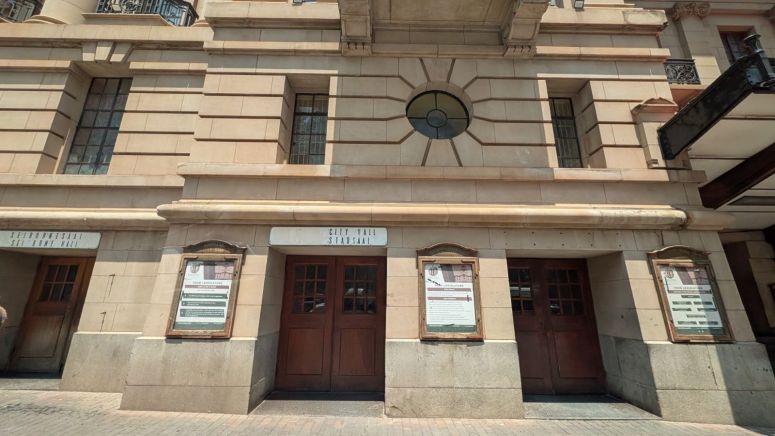
When we drove past the Johannesburg City Hall, we were heading up Helen Joseph Street, passing right alongside the building. Because we were so close to it and essentially looking from the back, I couldn’t fully appreciate its true scale or grandeur at the time, but it was around the corner I could see it’s towering copper dome. It was only doing research for this article that I realised what an interesting piece of history we had driven past.
The City Hall was designed in Edwardian Baroque style and officially opened in 1914. The City Hall is home to a remarkable pipe organ. In the 1920’s it was the largest organ in Africa and the second largest organ in the entire Southern Hemisphere. I found some good historic photographs of the city hall and the organ on the artefacts.co.za website.
Since 1995 the Gauteng Provincial Legislature operates out of the City Hall.


His Majesty’s Building
The next landmark that caught my eye was His Majesty’s Building. The name certainly wouldn’t have surprised me if we were driving around England, but it was a bit unexpected to spot it on a towering 19-storey skyscraper in downtown Johannesburg!
After a bit of digging, I found that the building was not named after King George VI, as I had presumed, but rather after a historic theatre built on the site in 1903 during the reign of King Edward VII. That original structure was eventually demolished to make way for a modern complex, with construction beginning in 1937. Although progress was halted by World War II, the building was finally completed in 1945. At the time of its opening, it featured a grand new theatre flanked by office towers topped with steel crowns that lit up at night. You can still see a nod to this royal theme in my photo, where a prominent red crown sits directly above the “EAST” entrance—right where a pedestrian happens to be stepping out onto the street.
Beyond entertainment, the office towers hold significant political history; anti-apartheid struggle hero and leading communist Advocate Joe Slovo once had his legal chambers here. The venue hosted its final theatre production in the early 1980s before being converted entirely into shops and offices. I noticed on the satellite view of Google Maps that the towers didn’t have their steel crowns on top anymore, they were possibly removed during the renovation. Today, it remains an active part of the city, bustling with retail stores, colleges, and businesses operating from its historic floors. I’ve included a historic aerial view of the buildings with the crowns from https://artefacts.co.za/main/Buildings/bldgframes_mob.php?bldgid=423.


The Rissik Street Post Office
Just across from the City Hall is the historic Rissik Street Post Office. Similar to my previous experiences of guessing a building had a bigger story to tell than initial assumption, after doing some digging I saw I was right. We passed a grand but deeply distressed red-brick building with a damaged clock tower. The Post Office was completed in 1897 and it was once the tallest building in Johannesburg!
Sadly, its recent history is a stark reflection of the inner city’s struggles. The building has stood officially empty since 1996, when the South African Post Office declined to renew its lease and moved out. What followed was decades of severe neglect and vandalism. In 2002, the bells in the clock tower were stolen and thieves even dragged the clock’s hands out of the building.
The devastation culminated in 2009 when a massive fire gutted the monument. This fire destroyed the top of the clock tower, which is why it looks so stunted and broken today, hardly resembling a clock tower. During my research I discovered that millions were spent on the renovation in 2016, but this confused me since the building still looks like a dilapidated wreck. Turns out the renovation was spent on putting up an internal steel skeleton and fix the roof so the burnt walls wouldn’t completely cave in. True renovation unfortunately was stalled. The bottom windows have been entirely bricked closed by the city in a desperate attempt to secure the remaining shell against squatters while it continues to sit empty.
I included a before photograph (curtsy of https://litdistrict.co.za/places/landmarks/rissik-street-post-office/) and the photo I took.


Transnet Building/ Carlton Hotel
I made another discovery while I was scouting the area on Google Maps, and discovered the Transnet building behind the Post Office is the old, famous Carlton Centre! The Carlton Centre complex represented the height of the Johannesburg CBD’s wealth. It featured a 5-star hotel, opened in 1972, where the rich and famous would rub shoulders. Over the years, its guest list included a who’s who of global icons and political figures, hosting everyone from Whitney Houston and Mick Jagger to Margaret Thatcher, and even serving as the lavish venue for Nelson Mandela’s 75th birthday celebration.
For a 46-year period, the complex’s 50-storey office tower was the tallest building in Africa. Its 50th floor featured an observation deck called the “Top of Africa,” which offered a stunning 360-degree view of the city. Attached to the tower was the 30-storey Carlton Hotel, which boasted its own luxury rooftop swimming pool.
It was as the financial wealth fled from Johannesburg’s CBD in the late 1990s, the hotel lost almost all of its business. It was officially closed and mothballed at the end of 1997. Transnet used the office building as their head office from 1999, but subsequently moved their staff to Midrand in 2018. Today, both the hotel and the towering office block sit mostly empty, although the underground shopping mall remains in use. (Image on the right from https://businesstech.co.za/news/property/799417/south-africas-top-luxury-hotel-became-a-deserted-and-dilapidated-building/)


Gandhi Square
As we came around the corner, I had my first sighting of Gandhi Square, and I was genuinely surprised by what I saw: a modern-looking, bright, clean, and well-maintained square surrounded by equally well-maintained and colourful buildings. I could see a mix of residential buildings and offices, cafes, banks, and restaurants. The square featured colourful potted plants—the type that would thrive in the hot summer conditions, like cacti and succulents. The centre of the square had a vibrant sculpture reading “Jozi, Gandhi Square,” and on the other side, in equally colourful letters in the form of a heart, “Jozi City, Egoli, City of Gold, All for One, One for All.”
Just on the other side of the square, I could see the bustling Gandhi Mall and the bus terminus. My first thought was, “Wow, this is the revived Johannesburg I was hoping to see.” It was the type of city attraction I would have felt comfortable getting out and exploring (but wouldn’t). Tapelo didn’t stop for more than a few moments, mentioning that although this is a fantastic example of urban renewal and there is security present, it still requires a high level of caution, especially for tourists unfamiliar with the area.
Doing some digging to write this post, I discovered that this square was historically established in the 1890s as Government Square, where the town’s first law courts operated. It later became known as Van der Bijl Square, and by the late 20th century, the bus terminus had fallen into severe decay, becoming a hotspot for crime as surrounding businesses fled the area.
Its story of rejuvenation started in the late 1990s when a property developer, Gerald Olitzki, worked alongside the city to redevelop the area. In 1999, it was named Gandhi Square to honour the late Mahatma Gandhi, who served as a lawyer in Johannesburg in his younger years, advocating for human rights and fighting early colonial racial discrimination. Gandhi had a pivotal part of his history in this area, with his legal offices just two blocks up the road. His statue depicts him dressed as his young professional self in his legal attire: a book in hand and his robes.


Standard Bank Head Office
Another historic building I found along the drive through the old financial district was the Standard Bank building on the corner of Harrison and Fox streets. I discovered it was the predecessor of Standard Bank Head Office in the Hanging Building. Similar to the grandeur of old buildings I could easily encounter on the streets of London or Dubin, this building caught my eye. After doing some research I discovered that this old Standard Bank building was built in 1907 in the classic Victorian architecture of the time. It was nominated in 1986 as one of Johannesburg’s top 100 historic places and has a unique construction: it is one of the city’s oldest remaining buildings with a steel skeleton, reinforced concrete floors and walls filled with brick and a sawn sandstone exterior. The building is still used today as commercial office space. The historic photograph from 1908 is sourced from https://en.wikipedia.org/wiki/History_of_Johannesburg#/media/File:JHFMARS_142_p2+p_005.jpg.


Johannesburg Central Magistrates’ Courts
Just further down Fox Street is a more recently built yet equally impressive building flanked by a 6-metre-tall statue: the Johannesburg Central Magistrate’s Court, completed in 1941. The statue that first caught my attention is none other than Nelson Mandela in sparring mode. Standing just outside the court (and directly across from the old law offices of Oliver Tambo and Mandela) the sculpture powerfully represents his fight for a free South Africa. Mandela trained as a boxer in the 1950s; however, rather than engaging in competitive fighting, he was fascinated by the science of the sport.

Tapelo let us know that their former law offices, located in Chancellor House, have actually been restored as an outdoor museum. While visitors cannot go inside, there are detailed historical exhibition boards set up in the ground-floor windows for the public to read.


Although Tapelo gave a fantastic explanation of what we were seeing in the city, there was so much more to be seen and the tour left me in a constant state of asking, “What’s that?”, “What building is this?”, and “What happened here?” Piecing together the history behind my photos became one of the most interesting subjects I have ever researched and written about.
Through falling down this research rabbit hole, I have learned an incredible amount compared to my previous, limited understanding of the Johannesburg CBD. The hours spent uncovering the stories hidden behind those bricked-up windows, modern mall walkways, and fading grand facades were entirely worth it to fully appreciate the complex, layered history of the City of Gold.
One day when I return, I hope to take another tour to discover what else I can learn and see what new developments the city has made. My continuous hope is for Johannesburg to stay on its path of rejuvenation, driving positive changes that support a vibrant and equal society.
References:
- Information on Google Maps for specific buildings
- https://www.getyourguide.com/johannesburg-l104/ultimate-johannesburg-tour-t182600/
- https://www.constitutionhill.org.za/home
- https://www.theheritageportal.co.za/article/old-park-station-heritage-site-exceptional-significance-comes-alive-again
- https://urbanstrategylab.com/the-fall-and-rise-of-the-heart-of-johannesburg/
- https://artefacts.co.za/main/Buildings/bldgframes_mob.php?bldgid=1350
- https://litdistrict.co.za/places/landmarks/rissik-street-post-office/
- https://artefacts.co.za/main/Buildings/bldgframes_mob.php?bldgid=423
- https://businesstech.co.za/news/property/799417/south-africas-top-luxury-hotel-became-a-deserted-and-dilapidated-building/
- https://www.ophprop.co.za/gandhi-square
- https://mg.co.za/2016-04-15-get-going-in-gandhi-square/
- https://en.wikipedia.org/wiki/History_of_Johannesburg#/media/File:JHFMARS_142_p2+p_005.jpg
- https://www.anvilproperty.co.za/commercial-property/office-space/to-rent/marshalltown/the-standard-bank-building-25556
- https://www.jda.org.za/archived/nelson-mandela-the-shadow-boxer/
- https://www.theheritageportal.co.za/article/magistrates-courts-blasts-apartheid-and-art